You often hear terms like Artificial Intelligence (AI), Machine Learning (ML), and Deep Learning (DL) tossed around. They dominate tech news, business strategies, and even daily conversations. Many people use them almost interchangeably. This mix-up is common because these fields are deeply connected.
Understanding the real differences is crucial. Businesses need this clarity to pick the right tools. Developers use it to build better systems. Enthusiasts gain a clearer picture of how technology works. What many don’t realize is their relationship is like nested dolls: DL fits inside ML, and ML fits inside AI.
This article will pull back the curtain on these powerful technologies. We’ll give you clear definitions and show how they relate. You’ll learn where each one shines, see real-world examples, and get a peek at what’s coming next. Get ready to finally demystify AI, ML, and DL.
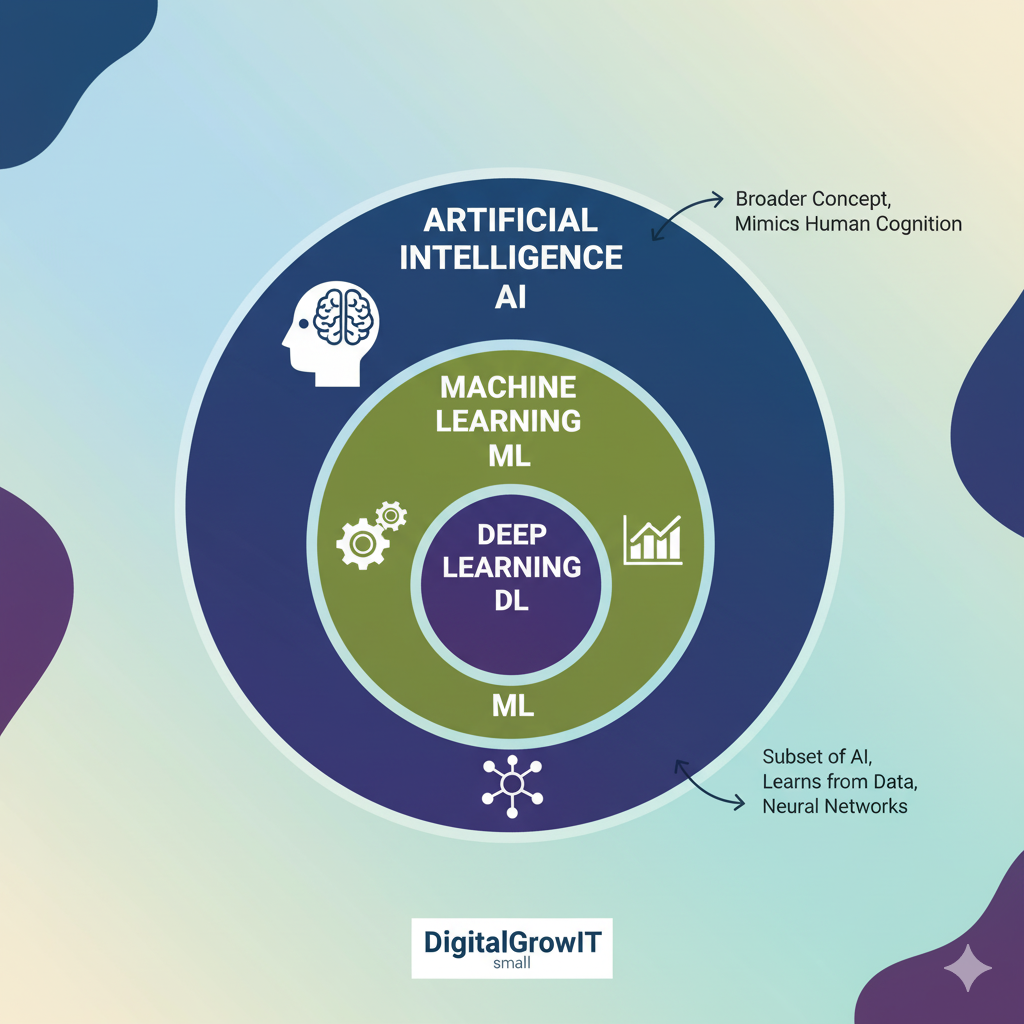
“A modern flat-style digital infographic comparing Artificial Intelligence (AI), Machine Learning (ML), and Deep Learning (DL). Use a clean, minimal, and professional design with light pastel background colors (like soft blue, light yellow, and mint green). Show AI as the broadest concept, Machine Learning as a subset within AI, and Deep Learning as a smaller subset within ML, using overlapping circles or a layered diagram. Include simple icons: AI with a robot/brain icon, ML with gears or data charts, DL with neural network nodes. Keep the design attractive, easy to understand, and suitable for a tech blog.”
What is Artificial Intelligence (AI)?
Defining the Broadest Concept
Artificial Intelligence is the biggest idea here. It’s the broad field focused on making machines smart. These smart machines can do tasks that usually need human thinking. Think of it as creating systems that can solve problems, reason, plan, or learn. They can also perceive their surroundings and understand human language.
The goal of AI is to give computers human-like mental skills. Early ideas about AI started long ago. Scientists wondered if machines could ever truly think. The famous Turing Test, for instance, asked if a machine could fool a person into believing it was human.
Types of AI
1.Artificial Narrow Intelligence (ANI)
- Also called Weak AI.
- Specialized in a single task (e.g., Siri, Alexa, chatbots).
- Cannot perform tasks outside its programming.
2.Artificial General Intelligence (AGI)
- Also called Strong AI.
- Has human-like cognitive abilities.
- Can learn, understand, and apply knowledge across different domains.
- Still theoretical (not yet achieved).
3.Artificial Superintelligence (ASI)
- Beyond human intelligence.
- Can outperform humans in creativity, decision-making, and problem-solving.
- A future possibility, with both opportunities and risks.
Real-World Examples of AI
AI is more than just learning from data. Early AI systems often followed strict rules. Expert systems, for instance, used human knowledge rules to make decisions in complex areas. Think of a program that diagnosed diseases based on symptoms. Game-playing AI like IBM’s Deep Blue, which beat chess grandmaster Garry Kasparov, showed early AI power. This wasn’t about learning from tons of data; it was about complex search algorithms and brute-force calculations. Early robotics also used AI for pathfinding and simple control, long before Machine Learning became popular.
Understanding Machine Learning (ML)
ML as a Subset of AI
Machine Learning is a major way we achieve AI. It’s a method that lets systems learn from data. What’s special is they learn without someone explicitly coding every single rule. Imagine teaching a child without giving them a fixed instruction manual. Instead, you show them many examples.
The main idea of ML is simple: systems improve their performance on a task by learning from experience, which means data. Think of it as building a brain that gets smarter with more information. Key parts of ML include the algorithms that do the learning, the data itself that they learn from, and the models that are created during this process.
The Learning Process in ML
So, how do these ML models learn? It all starts with data training. We feed large datasets into an algorithm. This data helps the model find patterns. Imagine showing thousands of pictures of cats and dogs to a computer. The process of getting data ready and picking the right parts of it is called feature engineering.
Different algorithms handle this learning in various ways. Supervised learning uses labeled data, like pictures marked “cat” or “dog.” Unsupervised learning finds patterns in data without labels. Reinforcement learning trains an agent to make decisions by giving it rewards or penalties. Once trained, we evaluate the model using specific metrics. This tells us how well it performs.
Common ML Algorithms and Use Cases
Machine Learning shows up everywhere. In supervised learning, models learn from known inputs and outputs. For example, your email spam filter uses supervised learning. It spots patterns in emails already marked as spam. Image classification and predicting when machines might break down also use this method. Algorithms like Linear Regression, Support Vector Machines (SVM), and Decision Trees are popular here.
Unsupervised learning finds hidden structures in data. It works with unlabeled information. Businesses use it for customer segmentation, grouping similar shoppers together. It also helps find strange patterns, like fraud, in anomaly detection. K-Means Clustering and Principal Component Analysis (PCA) are common unsupervised algorithms.
Reinforcement learning teaches an AI to make choices in an environment. It aims to maximize a reward. Google’s AlphaGo famously used reinforcement learning to beat the world’s best Go player. Robotics and systems for self-driving cars also rely on this type of learning. Agents learn through trial and error, just like people do.
Diving into Deep Learning (DL)
DL as a Subset of ML
Deep Learning is a specialized kind of Machine Learning. It uses artificial neural networks that have many layers. We call these “deep” architectures. Think of it like building a brain with a very complex structure. This structure helps it process information in a powerful way.
This approach often gets its inspiration from how the human brain works. Our brains have layers of neurons connected in complex ways. DL tries to copy this. The big innovation with Deep Learning is its ability to automatically find complex patterns in data. It learns different levels of understanding without needing human help to define specific features.
Neural Networks and Layers
At the heart of Deep Learning are neural networks. These are made of interconnected nodes, or “neurons.” Each neuron takes an input, does a small calculation, and passes an output. Think of these connections as pathways. Data flows through layers of these neurons.
You have an input layer where data first enters. Then comes one or many hidden layers, where the complex processing happens. Finally, an output layer gives the result. The more hidden layers a network has, the “deeper” it is. Activation functions are special math rules within each neuron. They help the network learn complex, non-straightforward relationships in the data.
Key DL Architectures and Applications
Deep Learning has birthed some amazing breakthroughs. Convolutional Neural Networks (CNNs) are perfect for images and video. They power object detection, recognizing faces, and even helping doctors analyze medical scans. CNNs revolutionized how computers “see.”
Recurrent Neural Networks (RNNs) and their advanced cousin, Long Short-Term Memory (LSTM) networks, handle sequential data. They are great for natural language processing (NLP). Think machine translation, where systems convert text from one language to another. They also make speech recognition work and can even generate new text.
More recently, Transformers have become the king of NLP. They’ve pushed the limits of what AI can do with language. Large Language Models (LLMs) like the GPT series and BERT use Transformer networks. They can write articles, answer questions, and even generate code. These powerful models often need massive datasets and huge amounts of computing power to train. Experts say the amount of digital data worldwide could top 180 zettabytes by 2025.
The Interplay: AI, ML, and DL
Visualizing the Relationship
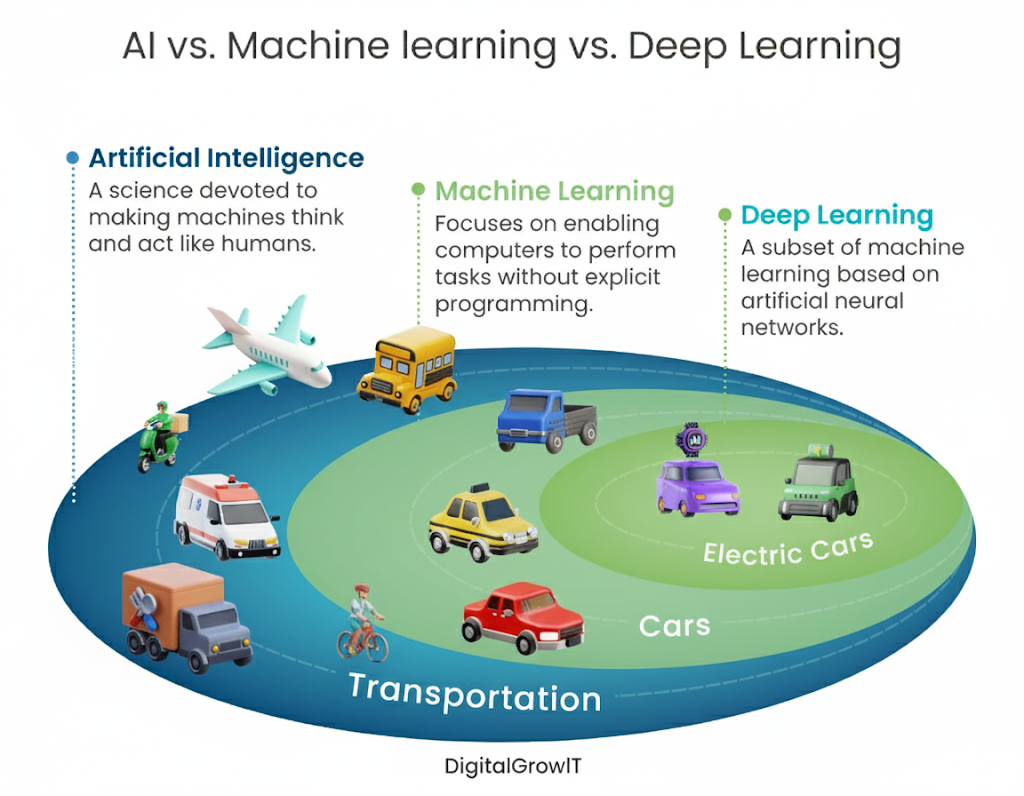
Imagine three nested circles. The biggest, outermost circle represents Artificial Intelligence. It’s the grand vision of making machines smart. Inside that, you have a smaller circle for Machine Learning. ML is one of the main ways we make AI happen. It focuses on systems learning from data. Then, right at the center, is the smallest circle: Deep Learning. DL is a very specific, advanced type of Machine Learning that uses deep neural networks. It’s a powerful method within a method.
When to Use Which Approach
Choosing the right technology depends on your problem and data. If you need a broad system that solves problems or reasons like a human, you’re looking at AI. This might involve expert systems or complex decision trees.
Machine Learning is your go-to for tasks where you have data, and you need to find patterns. It works well if you can define specific “features” in your data. Predicting customer churn, classifying emails, or forecasting sales are perfect ML jobs.
Deep Learning shines with really complex pattern recognition. It needs huge amounts of unstructured data, like raw images, audio files, or vast texts. If you want to recognize faces, translate languages, or build a self-driving car, DL is often the best fit.
The Role of Data and Computational Power
The rise of Machine Learning and Deep Learning wouldn’t be possible without two things: big data and massive computing power. Today, we generate incredible amounts of information every second. This “big data” provides the fuel these learning algorithms need. More data means smarter models.
Also, advancements in hardware are key. Graphics Processing Units (GPUs) and Tensor Processing Units (TPUs) are specially built to handle the complex math of neural networks. These powerful processors let us train much larger and deeper models than ever before. Without these two forces, much of today’s AI would still be science fiction.
Key Differences: AI vs. ML vs. DL:
| Feature | Artificial Intelligence (AI) | Machine Learning (ML) | Deep Learning (DL) |
|---|---|---|---|
| Scope | Broad concept of smart machines | Subset of AI focused on learning | Subset of ML using neural networks |
| Human Intervention | High (rule-based systems) | Medium (training + supervision) | Low (learns automatically) |
| Data Requirement | Works with less data | Requires structured data | Requires huge datasets |
| Examples | Siri, Chatbots, Robotics | Spam filters, Recommendations | Self-driving cars, Face ID |
Challenges and Future of AI, ML, and DL
Current Limitations and Ethical Considerations
Despite their power, these technologies face hurdles. One big issue is bias in data. If the data used to train an AI has unfair biases, the AI will learn those biases. This can lead to unfair outcomes. Another challenge is explainability, often called the “black box” problem. Deep Learning models can be so complex that we don’t always know exactly why they make a certain decision.
People also worry about job displacement as automation grows. Ethical questions around privacy and security are huge. Who owns the data? How do we keep it safe? These are big questions for us to tackle.
Emerging Trends and Innovations
The field is always moving fast. Federated learning is an exciting trend. It allows AI models to learn from decentralized data sources. This protects privacy by not sending all data to a central server. AutoML aims to make Machine Learning easier for everyone. It automates much of the model-building process.
Generative AI is a major leap forward. It creates brand new content, whether it’s text, images, or even code. We are already seeing its impact with tools that write essays or design art. Ensuring AI benefits all of humanity is also a focus. This is the field of AI safety and alignment.
Actionable Insights for Adoption
Ready to use AI, ML, or DL? Start with a clear problem. Define what you want to achieve before picking a technology. Remember, the best tool fits the task. Also, invest heavily in data quality. Clean, relevant data makes all the difference for good model performance.
You’ll need skilled people on your team. Build or acquire talent in data science and AI engineering. Stay informed about new breakthroughs. This field changes quickly, so continuous learning is important. As Fei-Fei Li once said, “AI is not just about technology, it’s about humanity.” Thinking about the human element is key to making these tools truly work for us.
Conclusion:
We’ve covered a lot today. Artificial Intelligence is the broad vision of smart machines. Machine Learning is a way to get there, letting computers learn from data. Deep Learning is a powerful type of Machine Learning that uses neural networks. Think of them as nested ideas, each building on the last.
These technologies are changing industries worldwide. They help us solve problems, make better decisions, and create new possibilities. They will only continue to grow more integrated into our lives.
The future holds exciting changes, along with new questions. Understanding these core differences empowers you to navigate this evolving landscape. The journey of intelligent machines is just beginning, and you are now better equipped to understand its path.